Virtual Human Breathing Coach
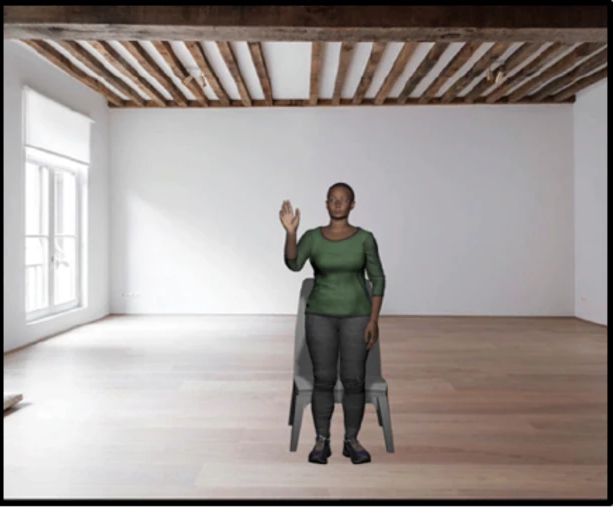
Guided breathing and slow-paced respiration are fundamental techniques for stabilising the autonomic nervous system, regulating heart rate, and mitigating psychological stress. While traditional clinical training relies heavily on expert practitioners to guide these practices, modern digital health interventions require automated, scalable alternatives. Our research specialises in the design, development, and empirical evaluation of virtual-agent-based systems for human-machine interaction in healthcare and mental well-being. Focusing on immersive and non-immersive interactive environments, this work investigates how automated interventions can be structured for stress management and behavioural support. One of the core innovation of this research, the Virtual Human Breathing Coach System, moves beyond static pacing tools by pioneering closed-loop, implicit interaction frameworks. This system harnesses the natural mechanisms of physiological synchrony found in human-to-human communication by using the breathing behaviour of an embodied virtual human coach as an ecologically valid physiological signal. Our research tracks how a system can continuously adapt its pacing to support a user's coordination while actively preserving user autonomy. Through a series of successive empirical evaluations, this research investigates the relationship between system adaptivity, immersion, and pacing control mechanisms. By mapping objective physiological metrics, alongside standardised psychological tracking and descriptive qualitative themes, this research provides vital empirical evidence and practical design frameworks for the future of digital health and artificial social agents. Recently, this innovation was awarded an EPSRC Impact Builder Award to test these adaptive digital tools directly into clinical environments within the NHS.
This work is part of the PhD project of Sanobar Dar.
This work is part of the PhD project of Sanobar Dar.
References
Usability, Acceptance, and the Role of Realism in Virtual Humans for Breathing Exercise Training . Sanobar Dar, Aniko Ekart, and Ulysses Bernardet. Scientific Reports , 15(1):1536, January 2025.When Agents Become Partners A Review of the Role the Implicit Plays in the Interaction with Artificial Social Agents . Sanobar Dar and Ulysses Bernardet. Multimodal Technologies and Interaction , 4(4):81, november 2020.